
Introduction
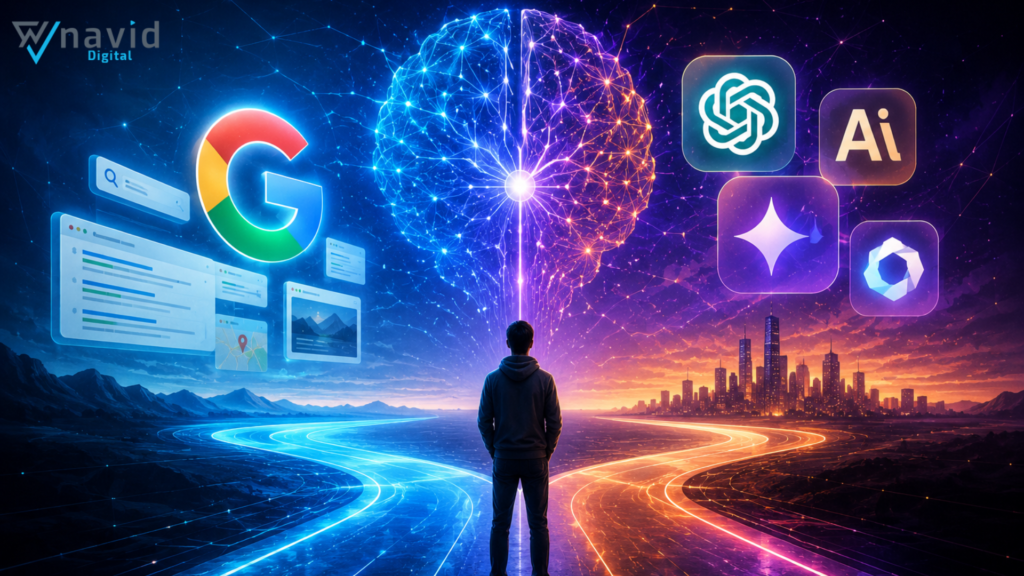
For more than two decades, Google has been synonymous with search. Whether people wanted to learn something new, compare products, or find local businesses, the journey almost always began with a search engine query.
Today, that journey is changing.
The rapid adoption of AI-powered platforms such as ChatGPT, Claude, Gemini, and Perplexity is transforming how people discover and consume information online. Instead of scanning through multiple search results, users increasingly expect direct, contextual, and conversational answers.
This shift represents more than just a technological advancement. It reflects a change in user expectations. People want faster answers, deeper context, and a more intuitive way to interact with information. As AI becomes a larger part of everyday digital experiences, businesses must rethink how they approach visibility, content, and search strategy.
At Navid Digital Services, we’ve observed a growing shift in how users interact with search platforms, prompting businesses to look beyond traditional SEO and explore emerging approaches such as AI Search Optimization, Answer Engine Optimization (AEO), and Generative Engine Optimization (GEO).
The future of search is no longer limited to search engines. It is expanding into a broader ecosystem powered by artificial intelligence.
From Keywords to Intent
Traditional search engines were designed to help users find relevant web pages. A user entered a query, and search engines returned a list of results based on relevance, authority, and hundreds of ranking signals.
Over the years, Google became increasingly sophisticated. Updates such as RankBrain, BERT, and MUM improved Google’s ability to understand context, user intent, and natural language.
The focus gradually shifted from matching keywords to understanding what users were actually looking for.
This evolution laid the foundation for the AI-driven search experiences we are seeing today.
The Rise of AI-Powered Search
The introduction of generative AI has accelerated the transformation of search.
Instead of browsing multiple websites, users can now ask complex questions and receive detailed, contextual responses within seconds. Platforms such as ChatGPT, Claude, Gemini, and Perplexity have made information retrieval more conversational, intuitive, and personalized.
What makes these platforms different is their ability to synthesize information rather than simply retrieve it. Users are no longer searching for pages; they are seeking answers, recommendations, and insights.
As a result, search is becoming less transactional and more interactive.
How ChatGPT, Claude, Gemini, and Perplexity Are Changing User Behavior?
Each platform brings a unique approach to AI-powered discovery.
ChatGPT has introduced millions of users to conversational search experiences. Gemini combines Google’s search ecosystem with advanced AI capabilities. Claude is widely recognized for delivering thoughtful, context-rich responses, while Perplexity blends conversational answers with source-based search experiences.
Although their approaches differ, they all contribute to a common trend: users increasingly prefer receiving direct answers instead of navigating through multiple search results.
This change is influencing how people research products, compare services, learn new concepts, and make purchasing decisions.
Google’s Response to the AI Search Revolution
Google understands that user expectations are changing.
The introduction of AI Overviews represents one of the most significant shifts in search history. Rather than displaying only traditional search results, Google can now generate summaries directly within the search experience.
For users, this creates a faster path to information.
For businesses, however, it introduces a new challenge. Visibility is no longer limited to ranking on the first page. Brands must also position themselves to be referenced, cited, and trusted within AI-generated responses.
This is where the future of search begins to intersect with the future of content.
Why Traditional SEO Is Still Important?
Despite the excitement surrounding AI search, SEO remains the foundation of digital visibility.
Search engines and AI systems still rely on high-quality content, technical optimization, authority signals, and user experience indicators to evaluate information.
Businesses that consistently publish helpful, accurate, and trustworthy content will continue to benefit regardless of how search technology evolves.
The difference is that content now needs to serve both human audiences and AI systems.
In many ways, AI search is not replacing SEO—it is expanding it.
The Emergence of AEO and GEO
As AI-powered search continues to grow, new optimization strategies are gaining attention.
Answer Engine Optimization (AEO) focuses on structuring content in a way that makes it easier for AI systems to understand and deliver direct answers.
Generative Engine Optimization (GEO) focuses on improving visibility within AI-generated responses and emerging AI search experiences.
While these concepts are still evolving, their underlying principle is clear: businesses must create content that is useful, authoritative, and easy for both humans and machines to interpret.
Organizations that begin adapting today will be better positioned as AI search becomes increasingly mainstream.
What the Future of Search Looks Like?
The future of search will likely be a hybrid ecosystem.
Google will continue to play a dominant role, but AI assistants such as ChatGPT, Claude, Gemini, and future technologies will increasingly influence how users discover information.
Search experiences will become more conversational, personalized, and context-aware. Users will move seamlessly between traditional search engines, AI assistants, voice interfaces, and emerging platforms depending on their needs.
As technology advances, one factor will remain unchanged: trust.
Regardless of how information is delivered, users will continue to value expertise, credibility, and authentic insights.
Conclusion
The evolution of search is no longer just a story about algorithms and rankings. It is a story about changing user expectations.
People want faster answers, better context, and more meaningful interactions with information. AI-powered platforms are responding to these expectations, reshaping how knowledge is discovered and consumed online.
For businesses, this transformation presents both a challenge and an opportunity. Those who embrace the changing search landscape and invest in creating valuable, authoritative content will be better positioned to thrive in the years ahead.
The future of search will not belong solely to Google, ChatGPT, Claude, Gemini, or any single platform. It will belong to brands that build trust, provide genuine value, and adapt to how people seek information in an increasingly AI-driven world.
Stay Ahead of the Future of Search
Search is evolving faster than ever, and businesses that adapt early gain a significant advantage.
At Navid Digital Services, we help brands navigate the changing landscape of SEO, AEO, GEO, AI visibility, and digital growth strategies.
Whether you’re looking to improve your Google rankings, strengthen your online presence, or prepare for the next generation of AI-powered search, we’re here to help.
Ready to future-proof your digital presence? Connect with Navid Digital Services and start building visibility where your audience is searching today – and where they’ll be searching tomorrow.